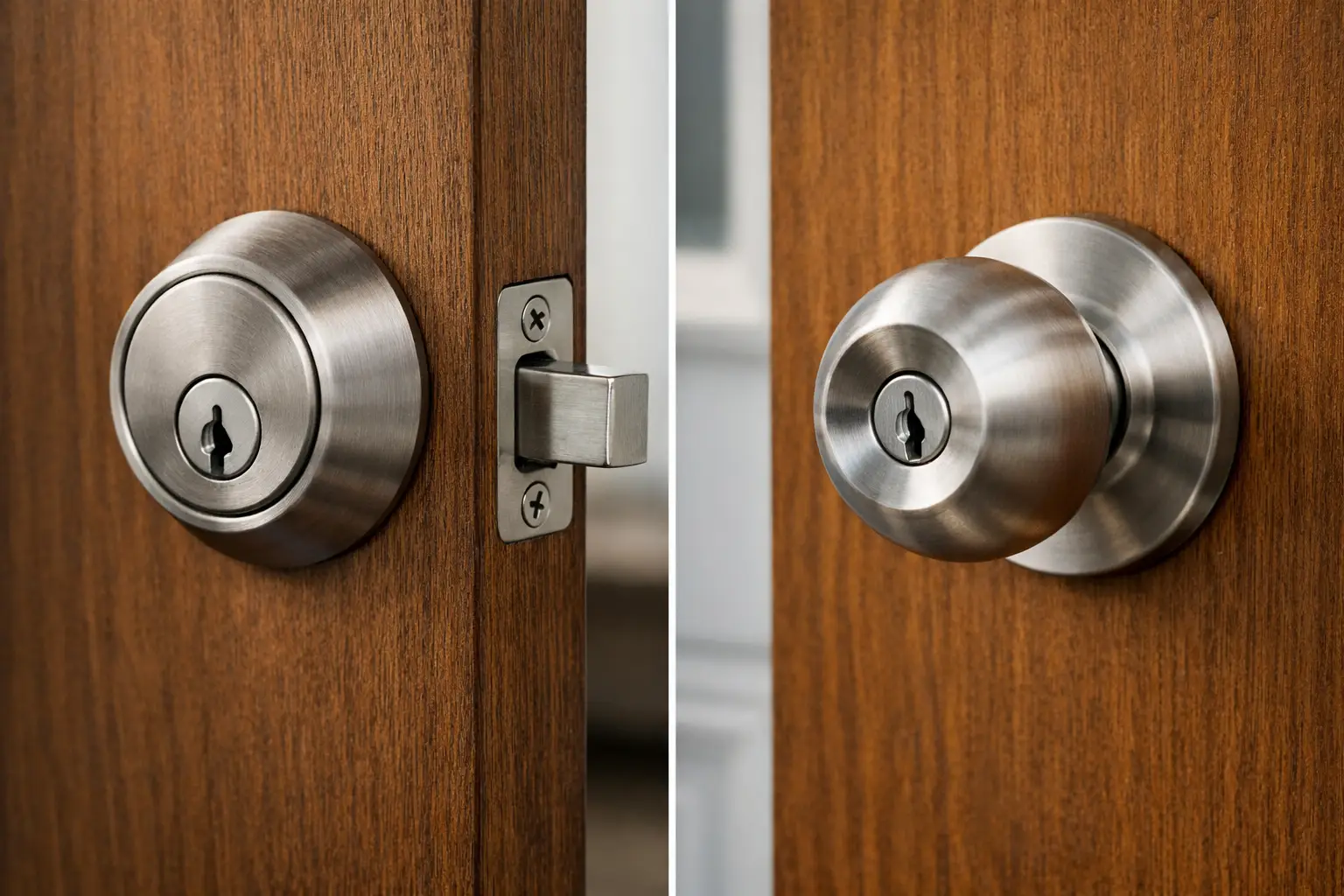
A front door that locks with only a knob may feel secure until someone leans on it, twists it hard, or targets the lock cylinder. In the deadbolt vs knob lock decision, the difference is not just appearance or price. It affects how well your door resists forced entry, how easily people can exit, and whether the hardware fits the way the property is actually used.
For most exterior residential doors, a deadbolt is the stronger primary lock. A locking knob still has a place, but usually as a companion to a deadbolt rather than the only security measure. The right setup also depends on the door, frame, occupants, local building requirements, and whether the property is a home, rental, storefront, or office.
Deadbolt vs Knob Lock: The Real Difference
A knob lock combines the handle and locking mechanism into one unit. When locked, the key cylinder prevents the knob from turning and retracting the spring latch. That latch is angled so the door can close behind you, and it retracts when the knob turns.
A deadbolt is a separate lock with a solid metal bolt that extends into the door frame. Unlike a spring latch, it does not retract from pressure on the outside of the door. It must be turned by a key, thumbturn, or electronic mechanism. That simple mechanical difference is why a properly installed deadbolt offers much better resistance to kicking, shoving, and latch manipulation.
A standard knob lock is not useless. It provides basic access control and a convenient handle for daily use. But the lock body and latch are generally less resistant to force than a quality deadbolt. On an exterior door, relying on a knob lock alone leaves a weak point that an intruder may exploit quickly.
Why a Deadbolt Usually Belongs on an Exterior Door
A deadbolt secures the door at the frame, which is where forced-entry attempts are often decided. When the bolt reaches deeply into a reinforced strike plate and the strike is anchored with long screws into the wall framing, the door assembly can handle substantially more force than it could with a simple latch.
The key phrase is properly installed. A high-quality deadbolt cannot make up for a loose frame, split jamb, thin door, or worn strike plate. If the door shifts when it closes, the deadbolt scrapes, or there is daylight around the frame, the problem may be the door alignment rather than the lock itself. Forcing a new lock onto a failing door can create more damage and still leave the entry vulnerable.
For Pittsburgh-area homes, weather and seasonal movement can also affect how a door fits its frame. Wood can swell, hardware can loosen, and older doors can sag over time. A locksmith can identify whether the practical fix is adjustment, strike reinforcement, a new deadbolt, or a more complete door repair.
When a Knob Lock Makes Sense
Knob locks work well on many interior doors, including bedrooms, bathrooms, utility rooms, and office spaces where privacy or basic controlled access is the goal. A locking knob may also be appropriate on a secondary interior door that is already protected by a secure exterior entry.
On exterior doors, a knob lock is most useful when paired with a deadbolt. The knob handles everyday opening and closing, while the deadbolt is locked when occupants leave or settle in for the night. This familiar two-lock arrangement is common because it separates convenience from security.
There are exceptions. Some doors cannot accept a traditional deadbolt because of their construction, glass layout, narrow stile, or proximity to another hardware opening. In those cases, the solution may be a different type of deadbolt, a reinforced latch system, a mortise lock, or another hardware upgrade chosen for the door itself. A lock should fit the door, not be forced into a bad application.
Security Is More Than the Lock Body
Comparing a deadbolt and knob lock without looking at the surrounding hardware can lead to a false sense of security. The lock is only one part of the opening. The door, hinges, frame, strike plate, screws, and installation quality all matter.
A solid or properly reinforced exterior door gives a deadbolt a better foundation than a hollow or damaged door. On an outswing door, exposed hinge security also deserves attention. Glass near the lock may change the recommended hardware, especially if someone could break the glass and reach an interior thumbturn.
Key control matters as well. If a former tenant, contractor, employee, neighbor, or lost key could still provide access, a stronger lock alone does not solve the problem. Rekeying allows the lock to work with a new key without necessarily replacing the entire hardware set. For rental turnovers and small businesses, that can be a practical and cost-conscious security step.
Deadbolt Types and Important Trade-Offs
Single-cylinder deadbolts use a key outside and a thumbturn inside. They are common in homes because occupants can exit quickly without finding a key. For most standard exterior doors without nearby breakable glass, this is often the sensible option.
Double-cylinder deadbolts require a key on both sides. They can limit access through adjacent glass, but they also create a serious exit concern during an emergency. They may be restricted by fire codes or local requirements, particularly in rental and commercial settings. Never install one simply because it sounds more secure without considering safe emergency egress.
Keypad and smart deadbolts can be useful for busy households, rental properties, and offices where codes need to be changed. They can reduce the need for spare physical keys and make access easier for approved users. Still, electronics do not eliminate the need for correct installation, a secure door frame, battery maintenance, and a reliable mechanical backup plan.
For commercial exits, a residential deadbolt is often not the right answer. Doors that serve the public or employees may require panic hardware, code-compliant exit devices, or access-control equipment. Security should never prevent people from leaving safely.
Choosing Hardware Without Overspending
The cheapest lock on the shelf can be expensive if it fails early, fits poorly, or has to be replaced after a break-in attempt. At the same time, the most expensive lock is not automatically necessary for every door. The best choice matches the risk level and daily use of the property.
For a typical owner-occupied home, a quality deadbolt paired with a compatible knob or lever, a reinforced strike plate, and professional alignment is usually a strong starting point. For a rental, rekeying between tenants and selecting durable hardware may matter more than decorative finishes. For a small business, key control, employee access, and safe exit requirements should shape the plan.
Look for established residential security ratings and durable construction, but do not buy based on packaging alone. Two locks with similar ratings can perform very differently after installation if one has a weak strike, short screws, or a poorly prepared door frame. Hardware quality and workmanship must work together.
Signs Your Current Lock Setup Needs Attention
Do not wait for a complete failure if your deadbolt sticks, the key turns roughly, the knob is loose, or the latch does not line up with the strike. Those are often early signs of wear, shifting, or internal damage. Continuing to force the key or twist the handle can turn a manageable repair into a lockout or a damaged door.
After a move, lost keys, a tenant change, attempted break-in, or employee departure, review who may still have access. If the property has a single exterior knob lock, consider upgrading before it becomes an urgent problem. A licensed and insured locksmith can assess the full opening, explain the options plainly, and provide honest pricing before the work begins.
A deadbolt does not need to be flashy to do its job. It needs to fit the door, engage the frame cleanly, allow safe exit, and be installed with care. If your entry hardware feels questionable, address it while you still have time to choose the right fix instead of making a rushed decision after a lockout or security scare.
One response to “Deadbolt vs Knob Lock: Which Secures Your Door?”
[…] is also the time to inspect the lock hardware. A master-key system can be compromised by a weak deadbolt, loose strike plate, damaged door frame, worn latch, or poorly aligned door. A key system controls […]