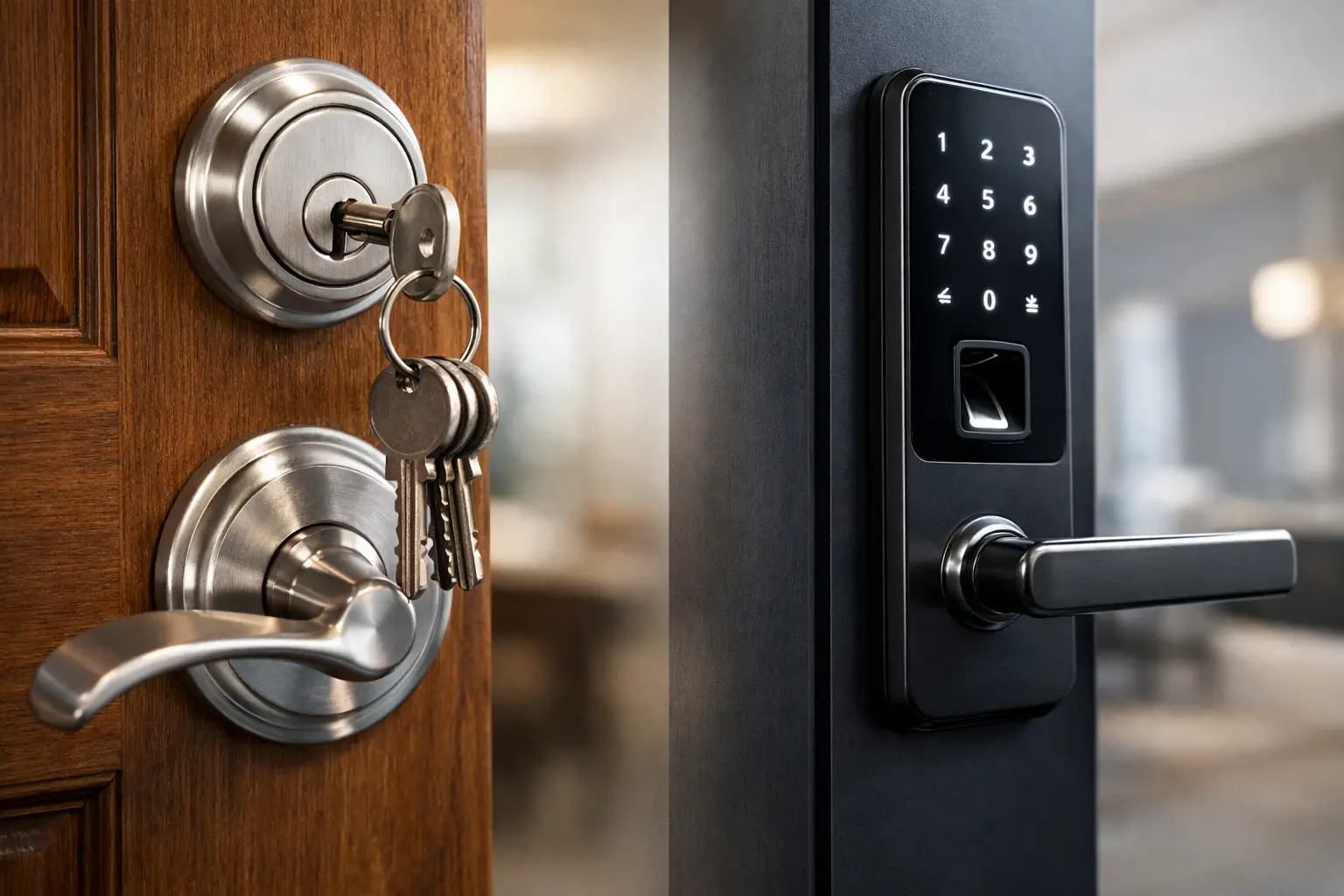
A front door that sticks at 10 p.m. makes people care less about features and more about one thing – will the lock work every single time? That is the real question behind mechanical vs electronic locks. Homeowners and business owners usually are not choosing between old and new. They are choosing between proven simplicity and added control.
The right answer depends on the door, the people using it, and how much risk comes from lost keys, shared access, or daily wear. A lock that makes sense for a single-family home may be the wrong fit for a rental, storefront, or office with frequent staff turnover. That is why this comparison needs to go beyond sales language and get into how these locks behave in the real world.
Mechanical vs electronic locks: the basic difference
A mechanical lock works through physical parts alone. You insert a key, turn a thumbturn, or operate a lever, and the internal components move without batteries, wiring, or software. Deadbolts, knob locks, lever locks, and many commercial cylinders all fall into this category.
An electronic lock adds powered access control. That can mean a keypad, key fob, card reader, app control, or smart lock features tied to Wi-Fi or Bluetooth. Some still include a traditional keyway as backup, while others are fully keyless.
That distinction sounds simple, but it changes how you manage access, maintenance, and failures. A mechanical lock tends to fail in visible physical ways, such as a worn key, sticky cylinder, or misaligned latch. An electronic lock can have those same door-related problems, plus battery issues, programming errors, or communication problems.
Where mechanical locks still make the most sense
Mechanical locks remain the standard for a reason. They are straightforward, durable, and familiar. For many homes, a quality deadbolt with proper installation offers exactly what is needed without adding complexity.
They also hold up well where reliability matters more than convenience. A side door, garage entry, storage room, or older building with inconsistent door alignment may be better served by a strong mechanical setup. Fewer components usually means fewer points of failure.
Cost is another factor. Mechanical locks are generally less expensive to buy and maintain. If you are securing multiple units or replacing several locks across a property, that difference adds up quickly. For landlords and property managers, rekeyable mechanical hardware can be a practical way to maintain control without overcomplicating tenant access.
Mechanical locks also make sense for people who do not want to depend on batteries, phone apps, or electronic credentials. Some customers simply want a lock, a key, and no surprises. That is not outdated thinking. It is a valid security choice.
Where electronic locks earn their place
Electronic locks solve a different set of problems. They are less about basic entry and more about controlling who gets access, when they get it, and how quickly that access can be changed.
That matters in rental properties, small offices, retail spaces, and homes with cleaners, dog walkers, contractors, or frequent guests. Instead of making copies of keys and hoping they are returned, you can issue a code, change it when needed, and keep better control over entry.
For businesses, the value often comes from speed and accountability. If an employee leaves, you can remove access without rekeying the entire door. If several people need access at different hours, you can assign credentials without passing around physical keys. In a busy workplace, that can reduce both inconvenience and risk.
Electronic locks can also be helpful for people who regularly lock themselves out. A keypad or app-based lock removes the need to carry a key every time. That convenience is real, especially for families with kids, older adults who prefer fewer keys, or homeowners managing deliveries and temporary visitors.
Security is not just about the lock type
When people compare mechanical vs electronic locks, they often assume electronic means more secure. That is not always true. Security depends on the quality of the hardware, the condition of the door and frame, and how well the lock is installed.
A cheap electronic lock on a weak door is still a weak setup. A properly installed grade-quality mechanical deadbolt on a reinforced frame can outperform a flashy smart lock installed on a loose, damaged jamb. The door, strike plate, screws, alignment, and overall hardware package matter just as much as the locking method.
Electronic locks do offer one security advantage that mechanical locks cannot match as easily: fast access changes. If a code is compromised, it can be updated. If a card is lost, it can be deactivated. With mechanical locks, a lost key may mean rekeying or replacing hardware to restore confidence.
On the other hand, electronic locks introduce digital and power-related vulnerabilities. Dead batteries, software issues, or poor setup can create access problems at the worst time. That does not make them unsafe. It just means they need to be chosen and maintained properly.
Reliability under daily use
Reliability is where the trade-offs get real. Mechanical locks tend to be more forgiving over time, especially in places with weather exposure, older doors, or heavy daily use. If the lock is good quality and the door is aligned, it can operate for years with minimal attention.
Electronic locks are reliable too, but they ask more from the user. Batteries need to be changed. Codes need to be managed. Sometimes the issue is not the lock at all but a door that has started sagging, a latch that no longer lines up, or a user who forces the mechanism instead of operating it correctly.
In western Pennsylvania, weather can also affect performance. Cold temperatures, moisture, and seasonal door movement can make any lock feel worse, but electronic hardware may need a little more attention in those conditions. A lock that works perfectly in mild weather may act differently when a door swells or shifts during winter.
That is why professional installation matters. A lock should not be fighting the door every time it closes. Whether it is mechanical or electronic, poor fit shortens the life of the hardware and creates avoidable service calls.
Cost over time
Mechanical locks usually win on initial price. Electronic locks usually win on convenience. The long-term value depends on how the property is used.
For a homeowner who rarely changes access and just wants dependable security, a mechanical deadbolt often delivers the best value. There are fewer maintenance needs, and quality hardware can last a long time.
For a landlord, office manager, or small business owner, electronic locks may save money over time by reducing rekeying, key replacement, and access confusion. If tenant turnover is frequent or staff changes happen often, those savings become easier to justify.
Still, not every property needs a full smart lock setup. Sometimes the best option is a hybrid approach – mechanical locks on low-priority doors and electronic access on main entry points where control matters most.
Which lock is better for homes, rentals, and businesses?
For owner-occupied homes, mechanical locks are often enough, especially when paired with solid hardware and good key control. Electronic locks become more attractive when convenience is a daily priority or when several people need flexible access.
For rentals, electronic locks can make turnover easier, but the hardware needs to be durable and simple for tenants to use. In some cases, a rekeyable mechanical lock is still the better fit, particularly in older buildings where doors are not perfectly aligned.
For small businesses, electronic locks usually offer more practical benefits. Staff changes, scheduled access, and the need for better control make them useful beyond basic security. That said, many commercial properties still rely on mechanical hardware for certain doors because it is dependable, code-compliant, and cost-effective.
How to choose without regretting it
Start with the problem you are trying to solve. If the issue is basic security, a high-quality mechanical lock may be all you need. If the issue is access control, lost keys, staff turnover, or convenience, electronic locks deserve serious consideration.
Next, look at the door itself. A warped frame, weak strike area, or poorly fitted door should be corrected before any lock upgrade. The best hardware in the world cannot compensate for a bad installation surface.
Then think about who will use the lock every day. Some users want simplicity. Others need temporary codes, app control, or audit features. The right lock is the one people can operate correctly without frustration.
If you are unsure, a licensed locksmith can usually spot the answer quickly by looking at the door, traffic level, and security goals. In many cases, the smartest recommendation is not extreme one way or the other. It is matching the lock to the actual use of the property.
A good lock should make life easier, not create a new source of stress. Whether you choose mechanical or electronic, the goal is the same: dependable access, honest security, and hardware that works when you need it most.
2 responses to “Mechanical vs Electronic Locks”
[…] bars, exit devices, mortise locks, cylindrical levers, and electric strikes can all fail in ways that prevent normal closing. A latch may stay retracted. The panic bar may not […]
[…] Electronic safes commonly fail because the batteries are dead or weak. Look for a low-battery indicator, a dim display, delayed keypad response, or no response at all. Some models have an external emergency power connection or a battery compartment that can be accessed without opening the door. Follow the manufacturer instructions for your specific model. […]